


Love your discomfort: running a bank of second-hand art materials
Text: Adel Kim
Proofreading: Anna Ruth
Text: Adel Kim
Proofreading: Anna Ruth
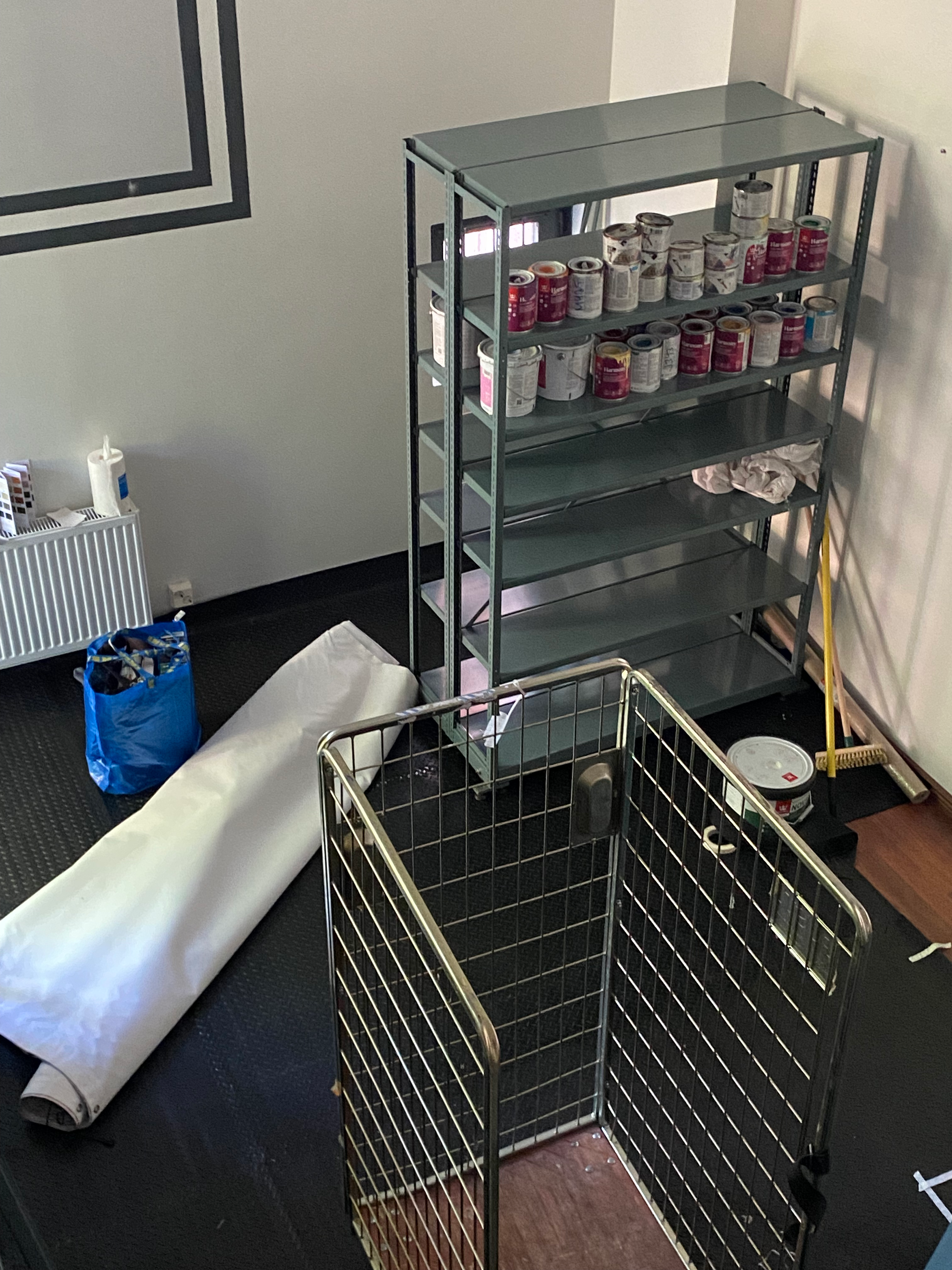
There are too many things in the world. This, hardly innovative, thought came to me as I organised small pieces of processed wood into storage boxes, arranged scraps of fabric on shelves, and pulled nails out of MDF boards during quiet evenings at SWAMP. Even within our modest 50-square-meter storage space, there are more items than I can meaningfully care for—too many objects to clean, touch, respect, or restore to some degree of decency. If I can barely comprehend the sheer variety of materials we already keep, what can be said about the countless other places filled with discarded remnants? And how could one even begin to imagine the volume of materials that end up in dumpsters after serving artistic needs in Helsinki, not to mention the world?
This essay reflects on my experience throughout 2024-25, with SWAMP, a material bank for second-hand art supplies and objects, co-established by Vera Kavaleuskaya and myself, and supported by the Kone Foundation and many wonderful people.
The current state of art related waste and the hierarchies of the Rs
Although art production creates a certain burden on the environment in various ways, e.g. through resource consumption, the main reason for climate anxiety in the arts sector is still related to the number of emissions it produces. According to a 2021’s estimation by Julie’s Bicycle, a non-profit organization focusing on climate action in the field of arts and culture, the art world’s global carbon footprint is in the order of 70 million tonnes CO2e per annum. (1) The most recent Art Council England’s environmental report indicates that waste takes a special place among the sources of emissions: in 2024-25, a total of 458 UK-based NPOs reported 38,245 tonnes of CO2 emissions were due to operational or project materials and waste.(2) Statistically, this was the second major contributor of indirect emissions of CO2, resulting in about 33% of all reported emissions, yielding first place only to energy (45%). All types of travel, including those of artist or crew and others, were left far behind resulting in about only 21% of all emissions. This suggests that while precarious art workers experience travel guilt and hesitate to take an extra flight per year, waste produced at the site of cultural organisations affects the climate crisis significantly more.
Numbers, percents and tons appear abstract; to put it more graphically, let’s imagine a typical museum exhibition. To set up an exhibition, temporary walls, pedestals, showcases and temporary furniture are built, the surfaces repaired and painted, the floors altered with carpets, the curtains are sewn and installed under the ceiling on rails. With a certain probability, when the exhibition ends, the equipment, some furniture and clean material leftovers will be stored and reused in future; however, chances are they will be dismantled and discarded after the exhibition period or a short time there after, alongside with all non-reusable pieces, such as Gyproc. Multiply this example to an average yearly number of exhibitions per venue, and then to the number of exhibition venues in the city; then add studio work and production and the waste that emerges during the creation process—this will give a very raw idea about how much valuable and potentially reusable materials end up each year, in refuse centres or combustion chambers, if they don’t find a new owner.
When it comes to waste management, there are widely known hierarchies of approaches, each vary, depending on the source: the classic “reduce-reuse-recycle,” or 3Rs, and 4Rs, 5Rs, 6Rs, possibly more. For instance, Ki Culture, an organization for sustainable actions in the fields of culture and heritage, and Gallery Climate Coalition, use the following: Refuse – Reduce – Reuse – Repurpose – Recycle.(3) While the top of this hierarchy is reserved for not using at all or using less, recycling always takes the last place for a reason. The idea of recycling is appealing and seems to be an easy solution of delegating the problem to professionals. However, it has major flaws: first, a big part of today’s mass-produced materials is not recyclable, while the number of cycles for recyclable ones is often limited and, depending on the material, might only be 2 to 10 cycles. In these cases, recycling often means downcycling, or producing a lower-quality product. (Exceptions are glass and metal, the cycles for which are unlimited). Second, the recycling capabilities vary depending on the country or the municipality and its local waste management. Finally, the process of recycling produces more emissions, and more resources are required.
As Gallery Climate Coalition’s Guide to Waste mentions, “we must minimise waste, rather than rely on recycling.” (4) John Miller and Robert O’Conner, senior technicians at Manchester Museums, second the statement: they emphasize that museums must reuse what they have got or, if it is not possible, find a recipient who would benefit from it, be it a charity organization or a local group. At the same time, a thorough plan for exhibition equipment and materials is required. (5) In other words, the main strategies include changing consumption behaviour, using materials more efficiently and reaching the limits of their use. Therefore, we can concentrate on buying less, using less, and reusing everything which was already bought and used—the only real solution is to move towards a circular economy.
Right place, right time
Given this background, the emergence of SWAMP was very timely. From the beginning, SWAMP aimed to collect materials destined to be discarded, from exhibition halls, art production venues, or from private houses and studios in the capital region of Finland, in order to make them accessible to art workers free of charge. Behind this simple intention lies the concern for and evidence of exhibition related waste and, more importantly, knowledge of the realities of an artist’s life.
Finland is truly a perfect match for such an initiative. Art organizations are striving to downsize their emissions and to communicate their environmental policies. Unlike many other countries, there is no need to convince institutional representatives and art workers of the obvious need for a feasible contribution to environmental action. This country has a strong culture of exchanging second-hand items; artists upcycle discarded materials or even develop new, harmless ones as substitutes, for instance, with plastic or silicone; organizations are pursuing circularity and green certificates, as with the EcoCompass by the Finnish Association for Nature Conservation. When SWAMP started, there were already so many initiatives and so much supportive research: guidelines, reports, recommendations for sustainable everything—museums, travels, residencies, studio practices, etc. There are even networks in the art field dedicated to sustainability that allow organizations to share practical, hands-on solutions with each other.
When sharing our project idea, we have often heard: “I have been thinking of the same!” The idea was not only in the air; the necessity of such storage was already indicated in reports and written resources about the Finnish arts sector. The LuoTo(6) preliminary report (2022) identified a need to provide circular economy services to visual arts professionals, such as the opportunity to borrow or buy used materials, in order to raise the efficiency of resource use.(7) The Vihreä Taide project, a cooperation of numerous Finnish art institutions, which developed a digital data bank, along with a calculation tool and currently operates as a network, recommended using Facebook groups or Kierräytyskeskus when searching for materials, in their Checklist for More Environmentally Sustainable Exhibition Production in 2024. (8)
Lastly, the field is undergoing a shift in its understanding of sustainability in a broader sense, adding the notions of financial, social, cultural and mental sustainability to the classical environmental interpretation of it. Sadly, action has become urgent: with the recently implemented financial cuts to the state’s support of the arts. Now small scale organizations and individual actors in the field find themselves in an even more precarious position. Without the ability to plan next year’s budget, not to mention the consideration of sustainable operations or even a career. Although SWAMP does not aim to cover all the core components of sustainability, it contributes to the financial well-being of art workers by providing materials for free. We cannot fix the systemic problem; however, support is tangible, as will be elaborated later in this text.
Solutions for art related waste
It would be easy to assume that all art exhibition venues have a surplus of leftover or used materials to share. This is only partially true: while museums or art halls have some degree of budgets for exhibition production, artist-run galleries and spaces have very little resources. These places often expect the exhibiting artists to do all the related installation and deinstallation of their show, find materials by themselves and clean the space afterwards. The availability to acquire, store, and give away materials depends on the organizational and financial structure of each venue. Not all institutions can supply materials for SWAMP, neither are all the material suppliers necessarily institutions: many individuals are also interested in giving away their collections. Given this, the work SWAMP is doing does not simply facilitate the exchange between institutions and individual art workers; rather it facilitates the surplus and lack of materials.
When it comes to art museums and halls, many of them have strategies, rules, or protocols for sustainability. From our conversations with organization representatives, we know that they strive to reuse or repurpose as much as they can on site. This is a common practice in other contexts too: for instance, Julie’s Bicycle’s report 2023-24 indicates that 74% of the organizations recycle their production/exhibition materials and re-use or re-purpose materials onsite. (9) However, not every pedestal or vitrine can fit the needs of the next exhibition, and not every institution can afford storing big pieces of exhibition furniture, LVL beams, or MDF sheets, as there are general limitations to storage spaces. Another obstacle for reusing the materials from dismantled exhibitions, is the quick turnover for reinstallation: sometimes it is more time efficient and even cheaper to buy new MFD sheets than repairing the old ones, even if the repair is minimal.
When storing items is not possible or desirable, there are always ways to give them away. This could be done via a Museoposti newsletter, or on social media in dedicated communities, or through personal connections. The main difficulty here is the personal effort: there are usually no designated staff members to deal with this task, which is usually extra, hand-tailored work. Often, the arrangements take a lot of communication and coordination effort.
It is important to mention, that none of these solutions are used exclusively, they form a mix tailored for each institution according to its needs and resources. We can, however, indicate that institutions need a quick, low effort and efficient solution, that would take the burden of managing leftover materials from them.
Art material sharing platforms in Finland and worldwide
When we were developing the idea of SWAMP, we didn’t rely on the experience of other similar initiatives worldwide; in fact, we didn’t know they existed. The knowledge of a great variety of models and ideas came to us while preparing the application, and later, through further research. I have collected the information on other material banks or material sharing platforms across Europe and North America, it is available via this link https://bit.ly/4z89htf . It is not, by any means, a complete list as many initiatives might only be known in their local communities. Our research also exposed a language barrier: some of the websites are only accessible in their local language, as they are meant for local use. Hopefully, one day we will have a comprehensive and regularly updated directory (there is one, prepared by the Gallery Climate Coalition but, unfortunately, some of the links are outdated). (10)
In Finland, before SWAMP emerged, the accessible resources were located online. For instance, the longstanding roinaränni group of Facebook works as a digital flea market for materials and props for exhibitions or stage use. It was opened in 2013, and currently has over 7,500 members. The group strives to support small and easy actions embedded into everyday life and connected to our regular routines. Another big Finnish initiative in this field is Goodstock.fi that offers an online trade and exchange platform for art-related equipment, props, and materials. Both platforms operate in Finnish.
Offline material exchange initiatives are often connected to an art community or institution, located at their premises and have limited access (therefore, not listed on the sheet). For instance, the Theater Academy TeaK has a material and stage construction warehouse, as well as props and costume storages for students’ needs. (11) On a smaller scale, exchange shelves are organized in artists’ residencies, shared studios or studio houses.
When we look at material redistribution initiatives internationally, several common operational models can be identified. Some function as online or offline stores, rental systems, or exchange platforms; materials may be offered free of charge or traded through symbolic forms of exchange. Certain initiatives are tailored to business-to-individual redistribution, while others focus on exchanges between individuals. Some maintain physical storage spaces, while others entirely operate online. Very few, however, receive regular institutional support, for instance from municipalities. Many projects also draw inspiration from platforms familiar to local users, such as the Gumtree or Too Good To Go. It is interesting to trace similarities in operational models, explanatory texts, and even the naming of conventions across different regions, as these reveal channels of influence, shared histories, and mutual learning, demonstrating that these projects do not emerge out of thin air. Sadly, as is often the case, not all of these initiatives have managed to sustain themselves over time.
Measuring efficiency: CO2 emissions saved by SWAMP
When you aim to affect the current state of things, you need tools for evaluating the outcome. For this reason, we started tracking our materials early on, beginning with our first visitors. After trying several approaches (rather unsuccessfully) we settled on calculating the amount of CO2 emissions saved through the redistribution of materials. This meant estimating the amount of CO2 emissions that would have been generated if an item had been purchased new instead of reused. These calculations allowed us to not only track our progress but also to compare our figures with reports from other organizations, thereby putting the results into context.
Despite the existence of CO2 calculators provided by Vihreä Taide, Julie’s Bicycle, and MoMA, the process was not without challenges. Firstly, all of these platforms are designed to calculate CO2 emissions generated through the production of art or exhibitions, not through the emissions avoided through reuse. This means that the calculations are based on the weight or dimensions of purchased materials, which are easy to obtain from order details. However, when calculating the saved CO2 of various materials of different scales, and sometimes unknown origins, additional work is required. Identifying materials and measuring the size or weight of an item is quite time- and labor-intensive for the operational staff, while also lengthening our visitors’ wait during checkout.
Secondly, not all items or materials are easily identifiable (it is not always possible to distinguish aluminum from steel at a glance) or even possible to quantify once identified. The available calculators offer extensive, but still limited lists of materials to choose from. Moreover, some items are made of composite materials, making accurate CO2 calculations nearly impossible. Our CO2 estimates therefore, could never be entirely precise. In the end, we chose to only use the calculator developed by Vihreä Taide, as it was the most comprehensive, locally grounded resource, and best suited to our needs.
Our CO2 statistics for 2025 show that more than 18,300 items or pieces of various materials were redistributed through a total of 1,728 visits (this figure does not indicate whether visits were made by unique or returning visitors). Of these items and materials, 72% were suitable for CO2 calculations, representing a total weight of 7,980 kg. The estimated amount of carbon emissions avoided through material redistribution is approximately 27.8 t CO2e. The most popular materials among our visitors were wood-based materials (4,604 kg), metal (1,397 kg), plastic (1,315 kg), paper (654 kg), and textiles (469 kg).
The total annual amount of avoided CO2 emissions is comparable to the yearly carbon footprint of some Finnish art organizations. For example, IHME Helsinki reported their estimated carbon emissions at 15.7 t CO2e in 2025, while somewhat older statistics published by Frame, in 2021, indicated approximately 41.8 t CO2e emissions related to their organizational operations, excluding grant activities. However, it is important to note that these calculations do not reflect the actual CO2 emissions generated by SWAMP’s own operations. Accounting for the project’s operational emissions would add an important dimension to the picture and should be considered in future assessments.
Experiences and findings
In SWAMP’s manifesto, we wrote: “Our goal is to make it easier to use second-hand art materials, than to buy something new.” To be completely honest, this goal is not achievable in the current reality. Using second-hand materials will always require additional effort: temporal (searching, inquiring, waiting), organizational (finding a vehicle, adjusting schedules, measuring and calculating how much material is needed), and physical (transporting materials from storage to a vehicle, cleaning and repainting them in one’s studio, or pulling old nails out of MDF boards). Although purchasing new materials also involves similar efforts, adapting your needs to the materials at hand is a much more tailored process, and the lack of additional infrastructure, e.g. delivery services, makes it more time-consuming than simply ordering from an online materials store.
Sustainable solutions are often criticized for being more expensive or time-consuming. (12) I would add that even free materials are not entirely free: instead of paying for the materials themselves, one pays for logistics and, possibly, repair. It would be much easier to order delivery and receive a brand-new item. Working sustainably involves a certain degree of discomfort. It also means that sustainable art production is not necessarily accessible to everyone.
Yet I believe this discomfort has value. Touching, reworking, and reflecting on materials considered “trash” can help us think critically about the alienation inherent in contemporary modes of consumption. Most of the time, as users of materials, we have only a vague understanding of the labor behind material production. Taking care of a piece of material can foster a deeper appreciation of the work and resources required to bring a single object into the world. Living and working sustainably is not, and probably never will be, easy, but it is a choice that one can make consciously.
Another insight the project has given me, is that despite the omnipresence and convenience of online platforms, offline modes of operation also have their strengths, particularly in the creative sector. Since many material redistribution initiatives operate online, the initial plan for SWAMP was to create an online catalogue or even a material exchange platform as an extension of the storage space. However, developing such a system proved to be extremely costly, while collecting and continuously updating information about every single item turned out to be unrealistic, given the volume of materials and the limited human resources available. As a result, SWAMP has remained primarily an offline storage space.
The feedback we received from visitors suggests that looking through materials can be both inspiring and enjoyable, and that physical engagement with materials encourages people to consider unexpected or unconventional uses. Artists often do not know in advance exactly how they will approach a particular task. The opportunity to observe, touch, and compare materials can generate new ideas and provide a better understanding of possibilities—something that only a physical space can offer.
From the beginning, SWAMP has maintained a subtle yet consistent relationship with hoarding. The first materials in the collection came from the co-founders’ own hoards, and one of our sources of materials continues to be the collections of other individuals. However, public perceptions of hoarding, particularly in relation to environmental impact, are generally negative, as it is often associated with waste and pollution, which adds further shame and guilt. Without addressing the health concerns of hoarding, we nevertheless offer an opportunity to create a “shared hoard” that gives this habit a communal dimension while reducing the fear of discarding something useful. This helps counteract the atomized consumption that encourages individuals to purchase, use, and ultimately dispose of products on their own due to the lack of exchange structures.
Naturally, there are still many issues to consider. As an organization, we wanted to make materials accessible to the widest possible audience of art workers. Therefore, we do not require visitors to provide proof of professional status or reports on how the materials are used. While this approach supports our mission, it also means that we cannot prevent, for example, the commercial use of the materials (although we have not encountered such cases, it is a frequently asked question), nor can we ensure that materials will continue to be managed sustainably or circulated for repeated use.
Another challenge is that although most materials eventually find new users, certain materials remain in storage for a long time. There is a possibility that some of the materials may never be reclaimed and might ultimately need to be discarded. As storage space is limited, not everything can be rescued. There are also unresolved issues regarding the physical accessibility of the storage space, the solution of which would require additional human resources. These challenges, among others, could be undertaken with further planning and development of the project.
Wrapping up
Long before I was introduced to environmental anxiety of any sort, I once had a nightmare about garbage disposal. In the post-Soviet apartment building where I lived as a teenager, waste was normally thrown into a garbage chute that ran through the whole building from top to bottom in the corner of the staircase, with a small door on each floor (it feels wild when I think about it now). A bag you feed to that stinky metal monster disappeared into the darkness with the sound of a long fall. It could never be retrieved or even seen again, and what would happen to an item was no longer under my control. One day, the horror of realizing this finality woke me up in the middle of the night.
In a sense, with SWAMP, I attempted to get things back under my control, to give some attention to unwanted objects that inhabit the world—but in a moderated and rather safe way. The amount of art-related trash is still overwhelming, but we can take care of objects within our reach and on our scale.
Adel Kim is a curator and researcher based in Helsinki. She co-founded SWAMP and co-curated it in 2024-2025.
- (1) Julie Bicycle, “The Art Of Zero. An indicative carbon footprint of global visual arts and the transition to net zero,” 2021. URL: https://juliesbicycle.org/wp-content/uploads/2026/02/ARTOFZEROv2.pdf (accessed Sep 2025)
- (2) Art Council England, Julie’s Bicycle. “Culture, Climate and Environmental Responsibility. Annual Report 2024-25,” 2026. URL: https://juliesbicycle.org/culture-climate-and-environmental-responsibility-annual-report-2024-25/ (accessed Apr 2026)
- (3) (Waste and Materials Ki Book KiCulture), https://galleryclimatecoalition.org/usr/library/documents/main/gcc-non-profit-and-institution-dap-2023-final.pdf
- (4) (GCC https://galleryclimatecoalition.org/recycling/)
- (5) Catherine Tindsley, “What Can Museums Do In Practice To Become More Sustainable?”. MuseumNext. October 15, 2022. URL: https://www.museumnext.com/article/greening-the-museum-a-never-ending-circle/ (accessed Nov 2025)
- (6) An online platform and knowledge base supporting the sustainability transformation in the creative sectors, coordinated by Helsinki-Uusimaa Regional Council. URL: https://luoto.art/en/ (accessed Nov 2025)
- (7) https://www.aalto.fi/sites/default/files/2022-11/LuoTo-raportti.pdf
- (8) https://www.vihreataide.fi/en/good-practices/environmentally-sustainable-exhibition
- (9) (https://juliesbicycle.com/jb/culture-climate-and-environmental-responsibility-annual-report-2023-24/)
- (10) Materials Sharing & Reuse Platforms. URL: https://fixed-maxilla-ce9.notion.site/8a3db29dd26c4c69832a314183c3f3fa?v=469546b7284a42a29bae76673e420cee (accessed Dec 2025)
- (11) Guide for sustainable artistic work at the Theatre Academy. URL: https://student.uniarts.fi/guides/guide-for-sustainable-artistic-work-at-the-theatre-academy/#further-information (accessed Nov 2025)
- (12) Sustaining Creativity. The Honest Guide to Sustainable Residencies. Cycle Up! 2025 https://www.goethe.de/resources/files/pdf353/sustaining-creativity_final.pdf